In What Way Can Art Create Connection Between Personal and Shared Knowledge?
Knowledge can have many forms. There is "knowledge by acquaintance", equally in knowing a person or identify. There is propositional knowledge, or "knowledge that" – for example, knowing that the UK voted to leave the EU in June 2016. There is too "knowledge how", as in knowing how to ride a cycle.
Only tin something every bit subjective and open to interpretation every bit art be knowledge? Art certainly involves noesis. An creative person may know how to draw using charcoal on paper, or know how to stretch a sail. But what about an actual artwork? Can it exist a type of knowledge? I call up information technology tin can, and as I contend in my new book, philosophy can help.
Today, more than and more academy art departments and schools regard art as a form of research, then as a "contribution to knowledge". This has largely come about due to research cess exercises that rank departments on their publications, and allocate authorities research funding based on the rankings.
Up until this point, art within academia had been taught every bit a serial of skills, as well every bit the exploration of ideas, along with some historical and theoretical context – only it had not been a research subject. And then "creative inquiry" was born. The only problem is that no one is entirely certain what that is.
Information technology is this dubiousness that makes the topic ripe for philosophical exam. The philosophies of art and knowledge have criss-crossed ane some other from Plato to the present, and, in doing and so, accept revealed the various ways in which art and knowledge can stand in relation to one another. At that place are many theories that work confronting the thought of art beingness cognition. Descartes's emphasis on noesis every bit "articulate and distinct" ideas, and John Dewey'south exclamation that art is "distinctively aesthetic" with its own "integrity" that lifts information technology to a higher place cognition, are just two examples.
However, there are philosophers who place fine art and knowledge in a more than constructive relationship. They focus on the nature of experience, and consider what kind of processes take to be at work in order to make experience continuous and meaningful. This locates noesis inside feel rather than something that exists apart from information technology.
One such philosopher is Immanuel Kant who argued that idea and awareness depend on one another. On this basis, the varieties of media and meanings that tin exist found in art, rather than beingness dismissed as uncertain subjectivities, are recognised as having an result on the wider circle of concepts through which a subject area is divers and articulated.
Art as enquiry
So what does artistic research look like? As with whatsoever inquiry, there is the initial scoping of the territory that identifies key themes, concepts and sources. With artistic research, some of the sources will exist artists and selected artworks. The interesting function is then looking at the exercise of the artist who is going to be the researcher, and how it and the territory combine to create a research question.
Have, for example, the study of intimacy conducted by performance artist Helena Sands as part of her fine art PhD at Cardiff Metropolitan University. Her literature review reveals that intimacy is open to a wide range of contrasting and alien meanings – for example, physical, sexual, at work, desired, unwanted, unexpected, and with strangers. It is this capacity for conflicting meanings that interested Sands. What being an artist enabled her to exercise was to consider the ways in which operation can articulate and extend this chapters for disharmonize.
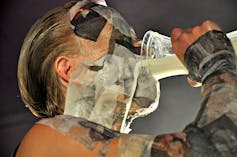
Her PhD performance DNR took objects that are connected with familial intimacy inside the habitation, such every bit photographs and milk. She applied them to her body, through pasting and pouring. The milk and the photographs acquired new, darker associations: the milk – normally a bond between female parent and kid and a source of nutrition – became a form that probed her body, soaking and damaging the family photographs that were placed on Sands' skin, turning images that had represented togetherness into symbols of separation.
So how is this cognition? By creating anarchistic combinations and arrangements, through performance, Sands made new ways of recognising how intimacy is surrounded by dissimilarity and conflict. What emerged from her work was the importance of concepts that lie on the borders of intimacy, and how performance tin can articulate these.
Creative research has its critics, simply they rely upon a romantic separation between art and other subjects. When artist Sir Michael Craig-Martin dismissed fine art PhDs for having merit only inside academia and not the art world, he failed to recognise that creative inquiry provides a setting in which artists can explore how their piece of work might bring new meaning to a field of study. Artists may have to adopt methods from other subjects, but these volition have aesthetic properties of their ain that tin add together to the art.
In that location is the worry that artistic enquiry might amount only to the illustration of research themes. But this can be avoided if the artist holds on to the autonomy of fine art, and its capacity for generating meanings through the expressions and surprises that come from exploring materials and situations in anarchistic means. These meanings are new – they are not just representations of existing propositions.
Source: https://theconversation.com/knowledge-can-take-many-forms-one-of-them-is-art-97745

Post a Comment for "In What Way Can Art Create Connection Between Personal and Shared Knowledge?"